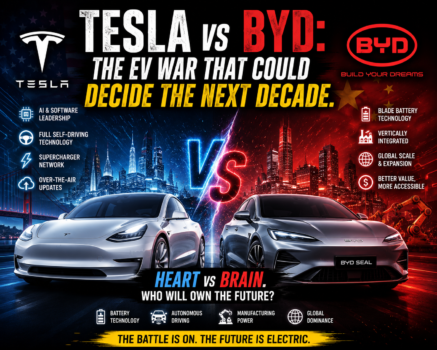
TESLA vs BYD: The EV War That Could Decide The Next Decade.
Silicon Valley’s Dream vs China’s Machine
Imagine it’s the year 2030.
You walk into an electric vehicle showroom somewhere in New York, Mumbai, or Bangalore. The sales consultant doesn’t ask whether you want a sedan or an SUV. He doesn’t ask whether you prefer a petrol car or an electric one. Instead, he asks a much bigger question.
“Tesla or BYD?”
At first, it sounds like a simple choice between two car manufacturers. But the deeper you look, the more you realize that this is no longer just a battle between two automotive brands. It is a clash of philosophies. A clash of nations. A clash between software and manufacturing. Between vision and execution. Between heart and brain.
For nearly a decade, Tesla has been the face of the electric vehicle revolution. When people imagined the future, they imagined a Tesla silently gliding down the road while updating itself through the internet. Tesla didn’t just build electric cars; it changed the way people thought about them. Before Tesla, electric vehicles were often seen as slow, boring, and practical machines designed primarily to reduce emissions. After Tesla, EVs became aspirational. Suddenly, electric cars were fast, exciting, futuristic, and desirable.
A large part of that transformation can be attributed to the company’s ability to sell a dream. Tesla doesn’t merely sell transportation; it sells a vision of tomorrow. The company has mastered the art of making customers feel like they are participating in the future. When people buy a Tesla, many are not simply purchasing a vehicle. They are buying into an idea. They are buying into innovation, artificial intelligence, autonomous driving, renewable energy, and the belief that technology can fundamentally improve everyday life.
And then there is Elon Musk.
Whether you admire him or criticize him, it is impossible to separate Tesla’s identity from the man who turned it into one of the world’s most influential companies. Musk has done something few automotive executives have ever managed to achieve. He transformed himself into a global technology icon. Every product launch, every ambitious promise, every discussion about artificial intelligence, Mars colonization, robotics, or autonomous vehicles adds another layer to Tesla’s mystique. To many enthusiasts, Tesla feels less like a car company and more like a technology company that happens to manufacture automobiles.
If Tesla represents the heart of the EV revolution, then BYD represents its brain.
While Tesla was capturing headlines and building one of the strongest brands in modern automotive history, BYD was quietly constructing an empire. Most consumers outside China had never heard of BYD until recently, but within the industry, executives have been paying close attention for years. The reason is simple. BYD has been playing a completely different game.
Tesla builds exceptional vehicles. BYD builds the ecosystem behind those vehicles.
Think of it this way. Imagine two chefs. One chef creates incredible dishes that customers love. The other chef owns the farms, the dairy facilities, the grain warehouses, the spice factories, and the transportation network supplying those ingredients. Both can succeed, but one controls far more of the process. That is essentially the difference between Tesla and BYD.
BYD manufactures batteries, electric motors, semiconductors, and many of the critical components that power its vehicles. This level of vertical integration gives the company extraordinary control over costs, production, and scalability. In an industry where supply chain disruptions can cripple manufacturers, BYD has built a system designed to minimize dependency on external suppliers. It is one of the reasons why the company has expanded so rapidly across international markets.
For EV enthusiasts, perhaps the most fascinating aspect of BYD’s rise is its battery technology. The company’s Blade Battery has become one of the most talked-about innovations in the electric vehicle industry. Battery technology remains the single most important component of any EV because it directly impacts range, charging speed, safety, and affordability. While Tesla has focused heavily on software and vehicle intelligence, BYD has concentrated on improving the foundation upon which every electric vehicle is built. In many ways, Tesla is teaching cars to think while BYD is strengthening the muscles that allow them to move.
This difference becomes even more interesting when we look at how each company approaches innovation. Tesla’s greatest strength has never been hardware alone. It has been software. Tesla vehicles receive over-the-air updates much like smartphones. Features improve. Interfaces evolve. Performance can increase. New capabilities appear without the owner ever visiting a service center. For many Tesla owners, this experience feels revolutionary. Their car doesn’t remain the same product they purchased years ago. It continuously evolves.
That is why Tesla owners often sound more like technology enthusiasts than traditional car buyers. Conversations that would normally revolve around horsepower or fuel economy instead focus on software versions, self-driving improvements, and artificial intelligence capabilities. Tesla successfully blurred the line between automotive engineering and consumer technology, creating an entirely new category of customer expectations.
Yet the future may not belong solely to the company with the best software.
It may belong to the company capable of scaling innovation across the globe.
That is where BYD becomes impossible to ignore.
The Chinese giant has demonstrated an ability to produce vehicles at an extraordinary pace while maintaining aggressive pricing strategies. In a world where affordability remains one of the largest barriers to EV adoption, BYD’s manufacturing efficiency gives it a powerful advantage. The company understands something fundamental about technological revolutions: great technology only changes the world when millions of people can access it.
This is why the Tesla versus BYD battle feels larger than a corporate rivalry. It represents two different approaches to shaping the future. Tesla embodies Silicon Valley’s belief that software and innovation will define the next generation of transportation. BYD embodies China’s belief that manufacturing excellence, supply chain control, and large-scale execution are equally important.
For readers in the United States, Tesla often feels like the natural favorite. The brand is deeply embedded within American culture. It symbolizes innovation, ambition, and technological leadership. But for readers in India, the equation becomes more complicated. Indian consumers have always balanced aspiration with practicality. They admire cutting-edge technology, but they also demand value. Tesla offers prestige, advanced software, and a globally recognized brand. BYD offers impressive battery technology, competitive pricing, and a rapidly expanding global presence. Both arguments are compelling, which is exactly why this rivalry has become so fascinating.
Perhaps the most exciting battleground lies in autonomous driving. Tesla has invested years of research and billions of dollars into creating vehicles capable of driving themselves. The company’s Full Self-Driving ambitions remain among the most ambitious technological projects in the automotive industry. However, BYD is no longer standing on the sidelines. The company is increasingly investing in intelligent driving systems, artificial intelligence, and advanced driver-assistance technologies. The race is becoming tighter, and the outcome remains uncertain.
Looking ahead, the next decade could redefine both companies. Tesla may evolve into an artificial intelligence company that sells cars as one part of a much larger ecosystem. BYD may become the Samsung of transportation, controlling not just vehicles but many of the technologies that power them. The ultimate winner may not be the company that sells the most cars. It may be the company that creates the strongest ecosystem around transportation itself.
So who wins?
The answer depends on what you value.
If you believe software, artificial intelligence, and autonomous driving will define the future, Tesla remains one of the strongest contenders on the planet. If you believe manufacturing scale, battery innovation, and supply chain control will determine the next generation of winners, BYD may prove unstoppable.
Tesla is the dream that inspired the EV revolution.
BYD is the machine that could scale it across the world.
Tesla is the heart.
BYD is the brain.
And as the world accelerates toward an electric future, one thing has become clear. The future of transportation will not be written by a single company. It will be shaped by the competition between these two giants.
The real question is no longer whether Tesla or BYD will influence the future.
The question is which one will own it.
If you had $50,000 in the United States or ₹45 lakh in India and could choose only one EV today, would you choose Tesla or BYD? More importantly, what does your answer say about how you see the future?